In Japan it is illegal to smoke and walk. There are several reasons for this, like to keep children from being burned. Another is that if you are walking the smoke can go any where. The last seems to be that smokers walking are more likely to just throw down the butt. There are a lot of signs about this kind of thing. They are in Japanese and odd, not quite wrong, but odd English. The diagrams though are what really make them so I hope that you enjoy this small tribute. Tune in next time for some Engrish. Click to make the pictures bigger.
Showing posts with label Japan. Show all posts
Tuesday, June 28, 2011
Saturday, May 7, 2011
A beer for kids?
Japan has a different set of expectations and beliefs when it comes to alcohol.
Here, a person can call "drinking " one of their hobbies. (Meaning that they drink, alone, almost every night.) Here, it's perfectly acceptable to get black-out drunk in front of your boss. In fact, it can help you score points with him to do so. Showing up to work hungover is more likely to elicit good natured ribbing than a stern reprimand. To be honest, I don't think that they have the same concept of alcoholism here. The common sentiment seems to be that so long as a person shows up for work in the morning, even if that person had a drink with breakfast, they don't have a problem.
Beer wine, and hard liquor are all easily available at grocery stores and konbini (Convenience stores. Image a gas station that doesn't sell gas.) Beer can still be purchased out of vending machines, although some of them now require legal ID.
With that speck of background I would like to introduce a product that Caleb and I stumbled upon:
THE KIDDIE BEER.

We found this in the candy section of the local grocery store. The name roughly translates to "Cheeky beverage". It was supposed to be "cider" flavored, and no, it wasn't alcoholic.
It came with a little plastic beer mug that you filled up to a line.
Afterward you poured in the powder.
The powder made so much foam, it overflowed onto the table.

I'm not sure what kind of taste we were expecting, but what we got was... well
It was sickly sweet. It didn't taste anything like beer, or cider.
It did look impressively like beer though.
Here, a person can call "drinking " one of their hobbies. (Meaning that they drink, alone, almost every night.) Here, it's perfectly acceptable to get black-out drunk in front of your boss. In fact, it can help you score points with him to do so. Showing up to work hungover is more likely to elicit good natured ribbing than a stern reprimand. To be honest, I don't think that they have the same concept of alcoholism here. The common sentiment seems to be that so long as a person shows up for work in the morning, even if that person had a drink with breakfast, they don't have a problem.
Beer wine, and hard liquor are all easily available at grocery stores and konbini (Convenience stores. Image a gas station that doesn't sell gas.) Beer can still be purchased out of vending machines, although some of them now require legal ID.
With that speck of background I would like to introduce a product that Caleb and I stumbled upon:
THE KIDDIE BEER.
We found this in the candy section of the local grocery store. The name roughly translates to "Cheeky beverage". It was supposed to be "cider" flavored, and no, it wasn't alcoholic.
It came with a little plastic beer mug that you filled up to a line.
Afterward you poured in the powder.
The powder made so much foam, it overflowed onto the table.
I'm not sure what kind of taste we were expecting, but what we got was... well
It did look impressively like beer though.
Wednesday, April 6, 2011
Just the Facts
Okay so here's the story.
We had been looking for some way, any way really, to help with the Tsunami relief effort. When the news came, it came quickly. We attended church for the first time since the earthquake on the 27th. Our local trains were not running before that time, and gas was scarce. There was literally no way to attend services. We had been communicating with the church members though. They knew that we were interested in volunteering. So on Sunday the 27th, they told us that there was going to be a Volunteer group that we could join, provided that we were willing to leave the next day.
So, with a quick call to Claire to see if she was in or out, we signed up.
Monday started at about 7 AM. We rode the local trains to Okunakayama, the town our church is in, and met up with the van that would be taking all of us to the coast. Then we had a 3 hour bus ride. Teperatures were not too cold. ( 0 Celcius is now my definition of "not too cold". ) Aside from a few closed stores and a gas station that was only allowing emergency vehicles, the edges of Miyako didn't look like a disaster area at all. A little further towards the coast and we started to see scenes like this:

We quickly arrived at Miyako church. We had lunch there and then divided into groups. Because the church was mostly clean we went out into the surrounding neighborhood to help. The men went to the nearby shops and houses, helping people bring their furniture outside to clean. The women were tasked with spreading this white powder around. The bag had several complex kanji on the side so, at first, Claire and I had no idea what we were spreading around. When we looked it up later, we discovered that we were spreading limestone, or chalk if you will, around. The chalk worked to wick up the excess moisture that was still a very big problem in the wake of the tsunami. We through it in alleys that had turned into mud slicks and in the rooms of houses where mold would soon be a problem when the warmth of spring hit. (We don't have many pictures of this time, or really of any other times we were working, because the work was filthy and we couldn't hold the camera.) After several hours of this we traveled, as a group to see the edges of the coast. These were the areas hardest hit. I don't really have much I can say about these pictures. I've tried to include some that Caleb hadn't already posted.

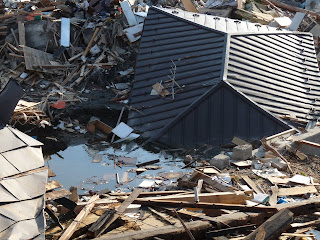


There is one thing Caleb forgot to mention entirely though. While we were walking through this area, we came across the amazing balancing log. Apparently the tsunami had washed some freshly cut logs away from some logging camp somewhere. One of these logs landed perfectly on top of the ladder used to climb down to the beach. If you poked it, as you see me doing below, it would wobble very slightly and very slowly, but it obviously had no intentions of falling off.


As I mentioned in an earlier post. Many houses had circles on them. I believe it meant that the house had been searched. Sometimes cars had them too.


After our trip to coast, we traveled to a kindergarten that still had power. We ate dinner together as a group and then split up. The women stayed in the kindergarten to sleep and the men went back to the church. The church did not have power and I am told it was a chilly night.
The next morning we ate breakfast and set off for Kamaishi.
When we pulled into Kamaishi church I was immediately struck by how surreal the situation was. The church building looked almost completely fine, with the exception of the fact that it was completely surrounded by rubble. The inside of the church was a completely different story. The main rooms had been shoveled out, but there were still places, such as the insides of cabinets and drawers, where the mud was three inches thick. Keep in mind that this was three weeks after the tsunami.
This is were I should make a note about Japanese dirt, or at least Iwate dirt. It's nearly black. Coming from a clay ridden state like Tennessee, I was shocked to discover that dirt did not have to be orange. Unfortunately in this case, Iwate's dark, rich soil makes a mud that will stain anything it touches. Any fabric or unvarnished piece of wood that was touched by the mud had a dark stain that could not be washed off.
We through so many things away. I learned a new term for trash ( gomi) so that I could ask if whatever thing I held in my hands was going to the wash pile or the trash pile. We saved plates and bowls, but threw out flatware and cutlery. All electronic devices went on the pile. We went by whatever the group leader told us. One of the only things I didn't have to ask whether or not to save was a metal communion tray.
After a long while, we managed to get the kitchen of the church relatively clean. It was at this point that we investigated the surrounding area some.

That evening, we spent the night in Tono church. The pastor and his wife layed out beds and futon for the women. Having a real shower and falling asleep under a down comforter felt like heaven.
This was hanging in Tono church. It is an image of Jesus washing feet, done in the traditional style of ink painting.
This is the sanctuary of Tono Church.
After breakfast, we returned to Kamaishi to continue our cleaning. This time we moved all of the donated materials into the kitchen that was cleaned the previous day. One of the women in our group started sorting the materials into boxes. Meanwhile, the rest of us tried to clean the sanctuary. 

This is what the sanctuary looked like when we were done cleaning. You can still see the mark on the walls where the water reached. We were instructed not to clean the walls, because all of the walls were going to have to be ripped out and replaced.
I wanted to leave you with an amusing story, so I saved this for last.
On the second day of our volunteer work, we all piled into the van and blearily tried to keep our exhausted heads from nodding. Our driver navigated through the rubble-filled streets. Out of nowhere Caleb shouts "Oh my god, a BEAR!"
All of us sat upright and screamed ( in both English and Japanese), " What? A bear!" We plastered ourselves to the passenger side windows and just barely manage to catch a glimpse of this:
It was a taxidermy bear, which we figured out when the van doubled back so we could all take a look. Looking at the pictures, it's perfectly obvious what it is. Getting only a seconds worth of a half glimpse in the middle of rubble though... well lets just say it looked a lot more alive.
We had been looking for some way, any way really, to help with the Tsunami relief effort. When the news came, it came quickly. We attended church for the first time since the earthquake on the 27th. Our local trains were not running before that time, and gas was scarce. There was literally no way to attend services. We had been communicating with the church members though. They knew that we were interested in volunteering. So on Sunday the 27th, they told us that there was going to be a Volunteer group that we could join, provided that we were willing to leave the next day.
So, with a quick call to Claire to see if she was in or out, we signed up.
Monday started at about 7 AM. We rode the local trains to Okunakayama, the town our church is in, and met up with the van that would be taking all of us to the coast. Then we had a 3 hour bus ride. Teperatures were not too cold. ( 0 Celcius is now my definition of "not too cold". ) Aside from a few closed stores and a gas station that was only allowing emergency vehicles, the edges of Miyako didn't look like a disaster area at all. A little further towards the coast and we started to see scenes like this:
We quickly arrived at Miyako church. We had lunch there and then divided into groups. Because the church was mostly clean we went out into the surrounding neighborhood to help. The men went to the nearby shops and houses, helping people bring their furniture outside to clean. The women were tasked with spreading this white powder around. The bag had several complex kanji on the side so, at first, Claire and I had no idea what we were spreading around. When we looked it up later, we discovered that we were spreading limestone, or chalk if you will, around. The chalk worked to wick up the excess moisture that was still a very big problem in the wake of the tsunami. We through it in alleys that had turned into mud slicks and in the rooms of houses where mold would soon be a problem when the warmth of spring hit. (We don't have many pictures of this time, or really of any other times we were working, because the work was filthy and we couldn't hold the camera.) After several hours of this we traveled, as a group to see the edges of the coast. These were the areas hardest hit. I don't really have much I can say about these pictures. I've tried to include some that Caleb hadn't already posted.
There is one thing Caleb forgot to mention entirely though. While we were walking through this area, we came across the amazing balancing log. Apparently the tsunami had washed some freshly cut logs away from some logging camp somewhere. One of these logs landed perfectly on top of the ladder used to climb down to the beach. If you poked it, as you see me doing below, it would wobble very slightly and very slowly, but it obviously had no intentions of falling off.

As I mentioned in an earlier post. Many houses had circles on them. I believe it meant that the house had been searched. Sometimes cars had them too.
After our trip to coast, we traveled to a kindergarten that still had power. We ate dinner together as a group and then split up. The women stayed in the kindergarten to sleep and the men went back to the church. The church did not have power and I am told it was a chilly night.
The next morning we ate breakfast and set off for Kamaishi.
When we pulled into Kamaishi church I was immediately struck by how surreal the situation was. The church building looked almost completely fine, with the exception of the fact that it was completely surrounded by rubble. The inside of the church was a completely different story. The main rooms had been shoveled out, but there were still places, such as the insides of cabinets and drawers, where the mud was three inches thick. Keep in mind that this was three weeks after the tsunami.
This is were I should make a note about Japanese dirt, or at least Iwate dirt. It's nearly black. Coming from a clay ridden state like Tennessee, I was shocked to discover that dirt did not have to be orange. Unfortunately in this case, Iwate's dark, rich soil makes a mud that will stain anything it touches. Any fabric or unvarnished piece of wood that was touched by the mud had a dark stain that could not be washed off.
We through so many things away. I learned a new term for trash ( gomi) so that I could ask if whatever thing I held in my hands was going to the wash pile or the trash pile. We saved plates and bowls, but threw out flatware and cutlery. All electronic devices went on the pile. We went by whatever the group leader told us. One of the only things I didn't have to ask whether or not to save was a metal communion tray.
After a long while, we managed to get the kitchen of the church relatively clean. It was at this point that we investigated the surrounding area some.

That evening, we spent the night in Tono church. The pastor and his wife layed out beds and futon for the women. Having a real shower and falling asleep under a down comforter felt like heaven.
This was hanging in Tono church. It is an image of Jesus washing feet, done in the traditional style of ink painting.

This is the sanctuary of Tono Church.

I wanted to leave you with an amusing story, so I saved this for last.
On the second day of our volunteer work, we all piled into the van and blearily tried to keep our exhausted heads from nodding. Our driver navigated through the rubble-filled streets. Out of nowhere Caleb shouts "Oh my god, a BEAR!"
All of us sat upright and screamed ( in both English and Japanese), " What? A bear!" We plastered ourselves to the passenger side windows and just barely manage to catch a glimpse of this:
Labels:
aftershock,
bear,
Church,
Earthquake,
Japan,
Kamaishi,
Miyako,
Tsunami,
Volunteer
Monday, March 14, 2011
Earthquake 2
The Board of Education had the Internet so we should be in a bit more regular contact. Ichinohe is still doing pretty good in a lot of ways. People are calm and going about normal activities as best they can. My school at Kozuya even had its graduation ceremony today. You could almost forget what had happened. Till there was a small aftershock during the ceremony. After the ceremony it was annocunced that the town was out of gas. Rumor is that most of the prefecture may be out as well. The local trains and shikansen are still closed in the north part of Japan. This is mostly to conserve power. The toll roads and main highways are reserved for emergency vehicles only. They are warning people in Tohoku(the north) and Kanto(central Japan) to conserve power as much as they can. With the disasters at Fukushima Daiich and Daini and troubles at other plants the national power situation is a bit difficult. There are going to be rolling blackouts in Tokyo and most of Kanto. I don't think that this will effect our town though we might lose power completely. I want to encourage everyone to look into how they can donate to the relief effort. Many people in Japan have lost everything and need alot of help.
They Japan Meteorological Association has said that there is a 70% chance of a magnitude 7 earthquake in the 3 days following March, 13.
One site that has been recommended as a place to donate is http://www.amazon.com/.
They Japan Meteorological Association has said that there is a 70% chance of a magnitude 7 earthquake in the 3 days following March, 13.
One site that has been recommended as a place to donate is http://www.amazon.com/.
Labels:
Afterschock,
donate,
Earthquake,
graduation,
Ichinohe,
Iwate,
Japan,
Kozuya
Saturday, March 12, 2011
Earthquake
We are both safe and ok. When the quake hit we were in Cokai at an after graduation party. It started out very slow with no one even seemin scared after it had gone for maybe 3 or 4 minutes it really picked up. Teachers opened doors to the outside and every one got ready to get under the tables. Half way through the first quake the electrcity wentout. At that point none of us hadany clue how bad it really was. All we knew was that our area seemed fine. The teachers sent all the kids outside and away from the building. People turned on their phones and we got news of the tsunami hitting the coast. All we did that day was go home and try and contact other teachers and friend and family back home. We didnt have any power and it was a cold night. The next day we walked around townand got flashlight candles and some food. Our town is very lucky no damage that we saw and no deaths. We were without power and much news for over 24 hours. Since the quake there have been alot of choppers flying over. Its 830 am on Sunday as I write this and we are still having after shocks. Last we heard about Ffukushima nuclear plants thhe evacuation zone was 20 kilometers. They had an explosion there around I think 3 yesterday. Also one of the reactor building roof had colapsed. Im watching the Japanese news and the pictures from the coast are awfull. It looks like whole towns are gone. The damage is very bad. Last figures I saw were 300 dead in Iwate most of that number seems to be from the town of Rikuzentakata. The news is running lists of dead at the bottom of the screen and one whole channel is just messages to family members. Please pray for everyone on the coast and the millions still without power. We are very fortunate we have food water power and neighbors who have checked on us. The only thing we dont have is internet. This is from our keindle.
Labels:
aftershock,
Earthquake,
fukushima,
Iwate,
Japan,
nuclear,
pray
Friday, June 18, 2010
Shoji
So maybe the wasp was too scary.
How about some Japanese home maintenance to calm everybody down?
When a westerner thinks of Japan they probably think of sushi, sumo, ninja, cherry blossoms and shoji. ( And those darned used panty vending machines. Yes, I've heard they exist. I've never crossed paths with one. Why is this considered the pinnacle of Japanese weirdness?)
Shoji, in case you don't recognize the name, are those sliding doors that divide off rooms in traditional Japanese houses. They are made out of some kind of lightweight wood and rice paper. They have a minimalist, clean look to them that westerners seem to instinctively love.
" I love the shoji! They're so pretty", I said to my tutor, brimming with naive enthusiasm.
" You love them because you are a westerner. I hate them.", said my tutor with a knowing grimace.
I now know why she hates them. The papers on the shoji has to be changed every so often.
I'm not sure how often they are supposed to be changed, but our shoji papers had little spots of mold on them in places so we decided it was time. I thought it would be a fun little project, and it was fun... for the first door.
I took some pictures to give you an idea of the process.
We start out here. It may be a little hard to see, but the paper is torn, mildewed and turning brown at the edges.

Step one: splash some water on it. I took the this picture because of how dramatic the splashing was, in reality though the goal is to completely saturate all of the paper.
Okay. Now that the whole thing is wet, you let it sit for a few minutes. This gives the water time to break down the rice glue that is holding the paper on the door. Next comes the fun part ( at least for me): stripping off the paper.

I get the strangest urge to play burlesque music in the background.

Now! The frame is all nice and bare and ready to be set out to dry.

Here's the pile of old papers that I pulled off. Oh and my feet sticking out into the picture.

And here are several frames sitting out to dry. I let them dry overnight to make sure I wouldn't have trouble with mold.

The next day I started here. I put the empty frame on the floor and applied rice glue to each and every little slat. Then I put the paper on... crooked. So I pulled it up, reapplied glue and tried again... this time I put it on upside down. So I pulled it up again, reapplied glue again and finally managed to get it on right.

Next, I take my trusty razor and trim away all the excess.
Much better, but now I had to do something scary. Caleb had talked to his teachers, and they all agreed that after you glue the paper down, you have to spray each panel with water to tighten the whole thing up. So I spray the thing down.
I am immediately certain that I have ruined all my painstaking effort. Little wrinkles appear in the paper and I hate every one of them.
After the paper dried though, I was treated to a happy surprise. What do you know, Caleb's teachers knew what they were talking about. The wrinkles were gone and the paper now made a very satisfactory, drum-like thump when tapped.

I'll leave you with this last image (even though Caleb completed the doors in this specific picture). Don't they just look lovely? I still like how shoji look, but I will never look forward to re-papering them again.
How about some Japanese home maintenance to calm everybody down?
When a westerner thinks of Japan they probably think of sushi, sumo, ninja, cherry blossoms and shoji. ( And those darned used panty vending machines. Yes, I've heard they exist. I've never crossed paths with one. Why is this considered the pinnacle of Japanese weirdness?)
Shoji, in case you don't recognize the name, are those sliding doors that divide off rooms in traditional Japanese houses. They are made out of some kind of lightweight wood and rice paper. They have a minimalist, clean look to them that westerners seem to instinctively love.
" I love the shoji! They're so pretty", I said to my tutor, brimming with naive enthusiasm.
" You love them because you are a westerner. I hate them.", said my tutor with a knowing grimace.
I now know why she hates them. The papers on the shoji has to be changed every so often.
I'm not sure how often they are supposed to be changed, but our shoji papers had little spots of mold on them in places so we decided it was time. I thought it would be a fun little project, and it was fun... for the first door.
I took some pictures to give you an idea of the process.
Step one: splash some water on it. I took the this picture because of how dramatic the splashing was, in reality though the goal is to completely saturate all of the paper.
Okay. Now that the whole thing is wet, you let it sit for a few minutes. This gives the water time to break down the rice glue that is holding the paper on the door. Next comes the fun part ( at least for me): stripping off the paper.
I get the strangest urge to play burlesque music in the background.
Now! The frame is all nice and bare and ready to be set out to dry.
Here's the pile of old papers that I pulled off. Oh and my feet sticking out into the picture.
And here are several frames sitting out to dry. I let them dry overnight to make sure I wouldn't have trouble with mold.
The next day I started here. I put the empty frame on the floor and applied rice glue to each and every little slat. Then I put the paper on... crooked. So I pulled it up, reapplied glue and tried again... this time I put it on upside down. So I pulled it up again, reapplied glue again and finally managed to get it on right.
Next, I take my trusty razor and trim away all the excess.
After the paper dried though, I was treated to a happy surprise. What do you know, Caleb's teachers knew what they were talking about. The wrinkles were gone and the paper now made a very satisfactory, drum-like thump when tapped.
I'll leave you with this last image (even though Caleb completed the doors in this specific picture). Don't they just look lovely? I still like how shoji look, but I will never look forward to re-papering them again.
Subscribe to:
Posts (Atom)